Week 7, Lesson 13, Monday
Describe your city
Russian adjectives copy the gender of their noun. Learn the four endings once, and every adjective follows them.
1Recap 5 minutes
Three questions from Week 6, before anything new.
2Goal 1 minute
I can describe a city, a home or a person with adjectives that match he, she, it or they.
3The lesson 20 minutes
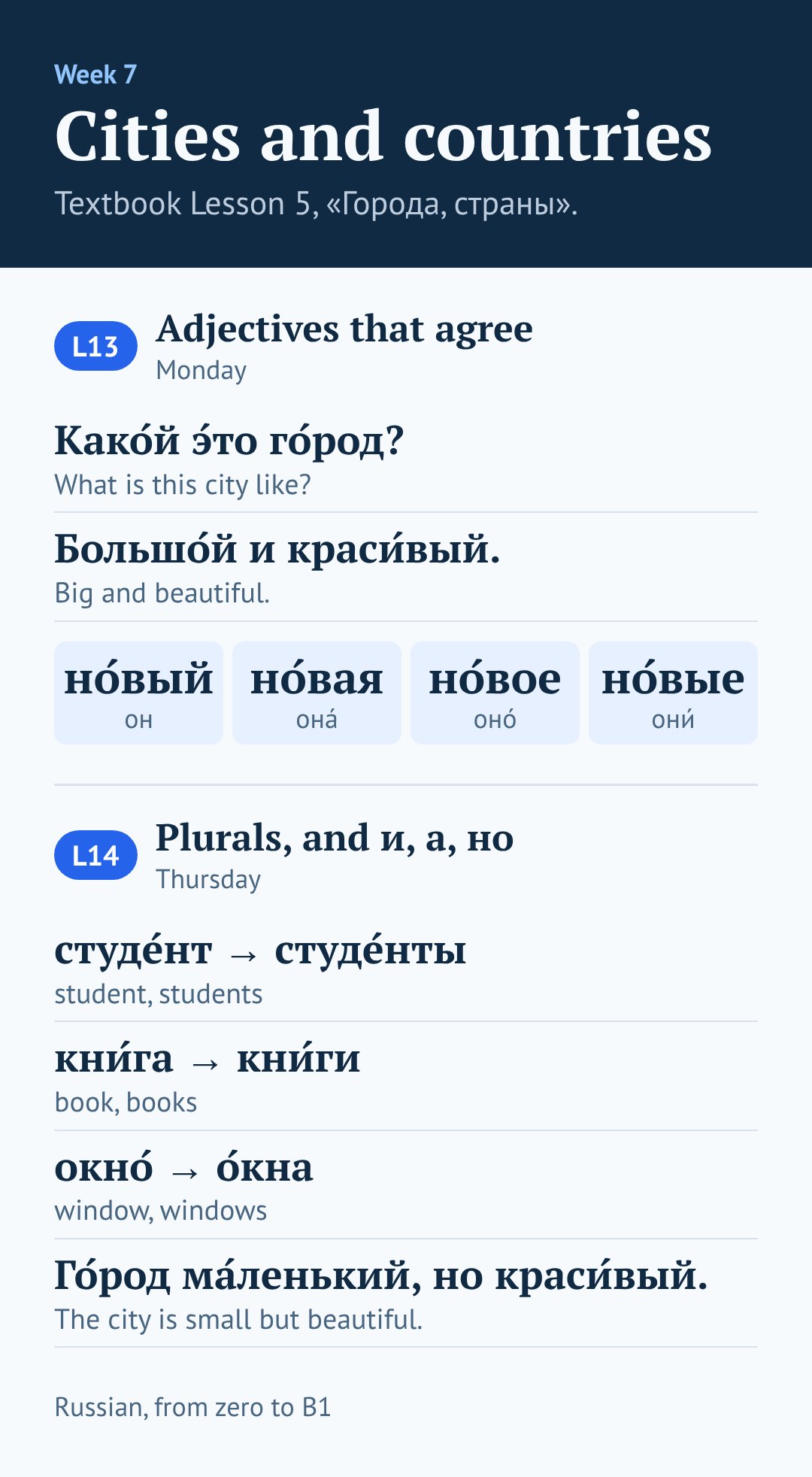
Како́й? Кака́я? Како́е? Каки́е?
Two cities, four adjectives. Compare the endings on the left with the endings on the right before reading on.
| Russian | Meaning |
|---|---|
| Како́й э́то го́род? — Большо́й. | What is this city like? Big. |
| Кака́я э́то у́лица? — Краси́вая. | What is this street like? Beautiful. |
| Како́е э́то окно́? — Большо́е. | What is this window like? Big. |
| Каки́е э́то дома́? — Но́вые. | What are these houses like? New. |
The four endings
Four endings cover every adjective. The coloured part is all that changes.
| он | она́ | оно́ | они́ | |
|---|---|---|---|---|
| new | но́вый | но́вая | но́вое | но́вые |
| big | большо́й | больша́я | большо́е | больши́е |
| Russian | ру́сский | ру́сская | ру́сское | ру́сские |
A stressed ending gives -о́й: большо́й, молодо́й. After к, г or х write и: ру́сский, ру́сские.
Opposites
Learning adjectives as opposites halves the work: you get two words for the effort of one.
| Russian | Meaning |
|---|---|
| большо́й / ма́ленький | big / small |
| но́вый / ста́рый | new / old |
| молодо́й / ста́рый | young / old (people) |
| краси́вый | beautiful |
| интере́сный / ску́чный | interesting / boring |
| хоро́ший / плохо́й | good / bad |
| ру́сский, мексика́нский | Russian, Mexican |
Learn them in pairs; it halves the work.
4Listen and say 5 minutes
Sound of the lesson: Let endings fall
Put your weight on the stressed syllable and let the adjective ending fall away quietly.
- ру́сский [RUS-kiy] Hear it on Forvo (opens in a new tab)
- краси́вая [kra-SI-va-ya] Hear it on Forvo (opens in a new tab)
Listen to the textbook
The book's own recordings for this topic, free on the publisher's site. Listen once for the gist, then again with the book open.
5Phrases and words 5 minutes
Phrases to learn whole
Learn each one as a single unit, the way you would learn a word. They come back in your Daily 10.
- Како́й э́то го́род?What is this city like?
- О́чень краси́вый!Very beautiful!
- большо́й и интере́сныйbig and interesting
- Э́то ста́рый го́род.It's an old city.
Words to read aloud
Read each one aloud, then open it to check.
большо́й / ма́ленький
big / small
Hear it on Forvo (opens in a new tab)но́вый / ста́рый
молодо́й / ста́рый
young / old (people)
Hear it on Forvo (opens in a new tab)краси́вый
интере́сный / ску́чный
interesting / boring
Hear it on Forvo (opens in a new tab)хоро́ший / плохо́й
good / bad
Hear it on Forvo (opens in a new tab)ру́сский, мексика́нский
Russian, Mexican
како́й
what kind, what is it like
Hear it on Forvo (opens in a new tab)у́лица
6Class exercises 15 minutes
Checked instantly. Get one wrong and you can try it again.
7Your turn 5 minutes
Describe your city with three adjectives.
See a model answer
Ме́хико — большо́й, краси́вый и интере́сный го́род.
Saved as you type. It goes to Екатерина together with Homework 13.
8Mini questionnaire required, 80% to pass
9Feedback 5 minutes
10Homework
Homework 13 on Tuesday: describe your city, your home and one person with adjectives.
I can describe a city, a home or a person with adjectives that match he, she, it or they.