Week 6, Lesson 12, Thursday
Describe your working day
Two verbs carry most small talk about your week: рабо́тать, to work, and учи́ться, to study. The second one ends in -ся, a small tail you will meet often.
1Recap 5 minutes
Three questions from Monday, before anything new.
2Goal 1 minute
I can say where and what I study and work, and describe my weekday.
3The lesson 20 minutes
рабо́тать: you know this one
Two colleagues meet at a coffee machine. Read their exchange, and notice that two different verbs both mean study.
| Russian | Meaning |
|---|---|
| Где вы рабо́таете? | Where do you work? |
| Я рабо́таю в о́фисе. | I work in an office. |
| Я рабо́таю до́ма. | I work at home. |
Pattern I, like чита́ть.
учи́ться: to study
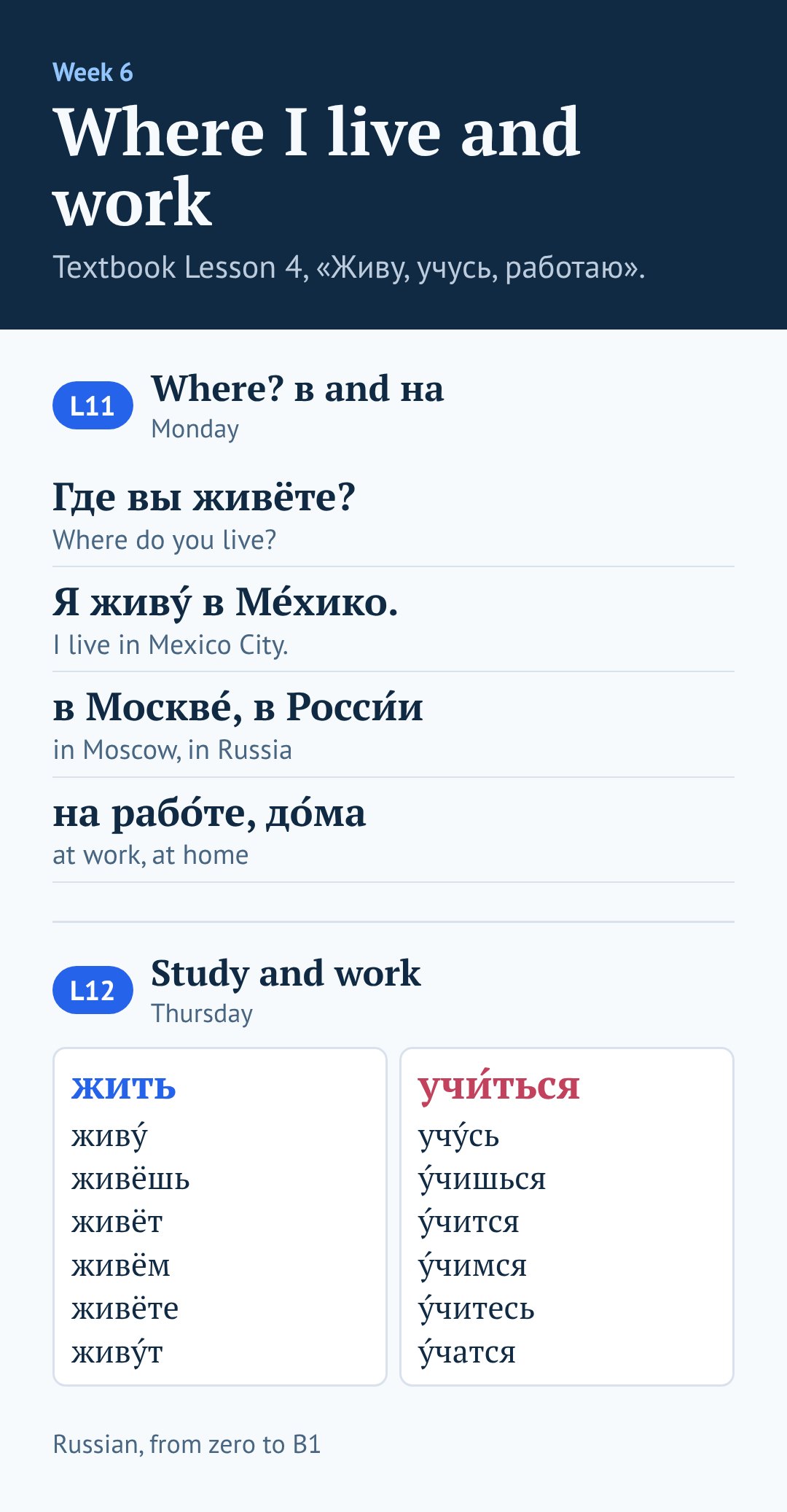
учи́ться is Pattern II with a small tail: -ся after a consonant, -сь after a vowel. The tail stays on every form.
| Person | Form |
|---|---|
| я | учу́сь |
| ты | у́чишься |
| он, она́ | у́чится |
| мы | у́чимся |
| вы | у́читесь |
| они́ | у́чатся |
Pattern II with a tail: -ся after a consonant, -сь after a vowel. The stress moves back after the я form.
учи́ться or изуча́ть?
| Russian | Meaning |
|---|---|
| Я учу́сь в университе́те. | I study at university. (where) |
| Я изуча́ю ру́сский язы́к. | I am studying Russian. (what) |
учи́ться says where you are a student; изуча́ть takes the subject. Your sentence: Я изуча́ю ру́сский язы́к.
Your weekday
Put the week together with the time words from Lesson 10. Notice how а moves from one part of the day to the next.
| Russian | Meaning |
|---|---|
| У́тром я рабо́таю. | In the morning I work. |
| Днём я рабо́таю до́ма. | In the afternoon I work at home. |
| Ве́чером я изуча́ю ру́сский. | In the evening I study Russian. |
4Listen and say 5 minutes
Sound of the lesson: -ться and -тся sound the same
учи́ться and у́чится are spelled differently but both end in the same sound: tsa.
- учи́ться [u-CHI-tsa] Hear it on Forvo (opens in a new tab)
- у́чится [U-chi-tsa] Hear it on Forvo (opens in a new tab)
Listen to the textbook
The book's own recordings for this topic, free on the publisher's site. Listen once for the gist, then again with the book open.
5Phrases and words 5 minutes
Phrases to learn whole
Learn each one as a single unit, the way you would learn a word. They come back in your Daily 10.
- Где вы рабо́таете?Where do you work?
- Я изуча́ю ру́сский язы́к.I'm studying Russian.
- Что вы де́лаете ве́чером?What do you do in the evening?
- Я учу́сь в университе́те.I study at university.
Words to read aloud
Read each one aloud, then open it to check.
рабо́тать
учи́ться
to study, be a student
Hear it on Forvo (opens in a new tab)изуча́ть
to study a subject
Hear it on Forvo (opens in a new tab)университе́т
university
Hear it on Forvo (opens in a new tab)о́фис
язы́к
ру́сский язы́к
the Russian language
что вы де́лаете?
what do you do?
6Class exercises 15 minutes
Checked instantly. Get one wrong and you can try it again.
7Your turn 5 minutes
Write your weekday in three sentences: у́тром, днём and ве́чером.
See a model answer
У́тром я рабо́таю. Днём я рабо́таю до́ма. Ве́чером я изуча́ю ру́сский язы́к.
Saved as you type. It goes to Екатерина together with Homework 12.
8Mini questionnaire required, 80% to pass
9Feedback 5 minutes
10Homework
Homework 12 on Friday: describe a normal weekday, and ask Екатерина two questions about hers.
I can say where and what I study and work, and describe my weekday.