Week 3, Lesson 6, Thursday
Say what you do every day, and your age
Every regular Russian verb in the present follows one of two patterns. Learn which one when you learn the verb, and you never have to guess again.
1Recap 5 minutes
Three questions from Monday, before anything new.
2Goal 1 minute
I can use present-tense verbs of both patterns and say numbers up to 100, including an age.
3The lesson 20 minutes
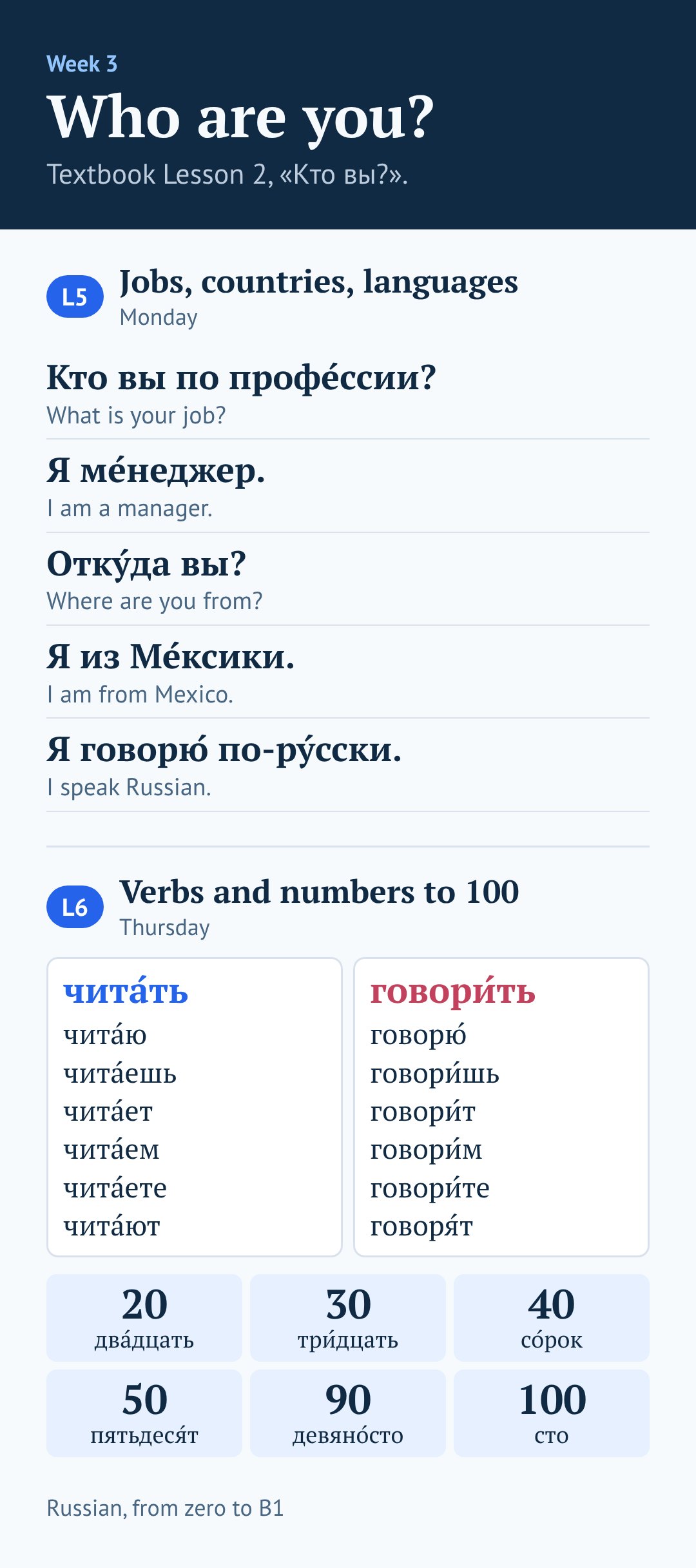
Pattern I: чита́ть, to read
Russian verbs change their ending for each person. The good news: almost every regular verb follows one of two patterns, and the endings repeat. Pattern I keeps an е in the middle: чита́ешь, чита́ет.
| Person | Form |
|---|---|
| я | чита́ю |
| ты | чита́ешь |
| он, она́ | чита́ет |
| мы | чита́ем |
| вы | чита́ете |
| они́ | чита́ют |
Same pattern: знать, рабо́тать, ду́мать, понима́ть.
Pattern II: говори́ть, to speak
Pattern II swaps that е for an и: говори́шь, говори́т. When you learn a new verb, learn its ты form too; it tells you the pattern.
| Person | Form |
|---|---|
| я | говорю́ |
| ты | говори́шь |
| он, она́ | говори́т |
| мы | говори́м |
| вы | говори́те |
| они́ | говоря́т |
Numbers 11 to 100
From 11 to 19, numbers end in -надцать, a worn-down на де́сять, on ten: оди́ннадцать is one on ten. The tens follow a pattern too, with one rebel: со́рок.
| Number | Russian |
|---|---|
| 11 | оди́ннадцать |
| 12 | двена́дцать |
| 13 | трина́дцать |
| 14 | четы́рнадцать |
| 15 | пятна́дцать |
| 20 | два́дцать |
| 30 | три́дцать |
| 40 | со́рок |
| 50 | пятьдеся́т |
| 60 | шестьдеся́т |
| 70 | се́мьдесят |
| 80 | во́семьдесят |
| 90 | девяно́сто |
| 100 | сто |
Build the rest: два́дцать пять is 25, со́рок оди́н is 41.
Your age
Age is said with мне, to me: literally, to me are 25 years. The word for years changes with the number, which is why learners collect three forms.
| Russian | Meaning |
|---|---|
| Ско́лько вам лет? | How old are you? (formal) |
| Мне два́дцать пять лет. | I am 25. |
| Мне два́дцать оди́н год. | I am 21. |
| Мне три́дцать два го́да. | I am 32. |
год after 1, го́да after 2 to 4, лет after 5 to 20; from 21 on, the last digit decides.
4Listen and say 5 minutes
Sound of the lesson: ы is its own sound
For ы, pull your tongue back and keep your lips relaxed. Keep it apart from и: мы is not ми.
Listen to the textbook
The book's own recordings for this topic, free on the publisher's site. Listen once for the gist, then again with the book open.
5Phrases and words 5 minutes
Phrases to learn whole
Learn each one as a single unit, the way you would learn a word. They come back in your Daily 10.
- Что вы де́лаете?What are you doing?
- Ско́лько вам лет?How old are you?
- Мне … лет.I am … years old.
- Я говорю́ по-ру́сски.I speak Russian.
Words to read aloud
Read each one aloud, then open it to check.
чита́ть
[chi-TAT'] to read
Hear it on Forvo (opens in a new tab)говори́ть
[ga-va-RIT'] to speak
Hear it on Forvo (opens in a new tab)знать
[znat'] to know
Hear it on Forvo (opens in a new tab)рабо́тать
[ra-BO-tat'] to work
Hear it on Forvo (opens in a new tab)ду́мать
[DU-mat'] to think
Hear it on Forvo (opens in a new tab)понима́ть
[pa-ni-MAT'] to understand
Hear it on Forvo (opens in a new tab)6Class exercises 15 minutes
Checked instantly. Get one wrong and you can try it again.
7Your turn 5 minutes
Write three things you do, and your age.
See a model answer
Я чита́ю. Я рабо́таю. Я говорю́ по-ру́сски. Мне три́дцать лет.
Saved as you type. It goes to Екатерина together with Homework 6.
8Mini questionnaire required, 80% to pass
9Feedback 5 minutes
10Homework
Homework 6 on Friday: five true sentences with verbs, your age in words, and counting by tens aloud.
I can use present-tense verbs of both patterns and say numbers up to 100, including an age.